

















Introduction to Inventory
Inventory keeps track of the stock of your items. Frappe Books records each movement of stock into a location, out of a location, or between two locations. It also calculates the value of your stock and records this value in your accounts.
Turn On Inventory
Only a Books Manager or a System Manager can change the settings.
- Click Setup > Settings in the sidebar.
- In the General tab, turn on Enable Inventory.
- Click Save.
- Click Yes to reload Frappe Books.
The sidebar then shows the Inventory group and the stock reports. You can also turn on the Point of Sale (POS).
| Page | Use |
|---|---|
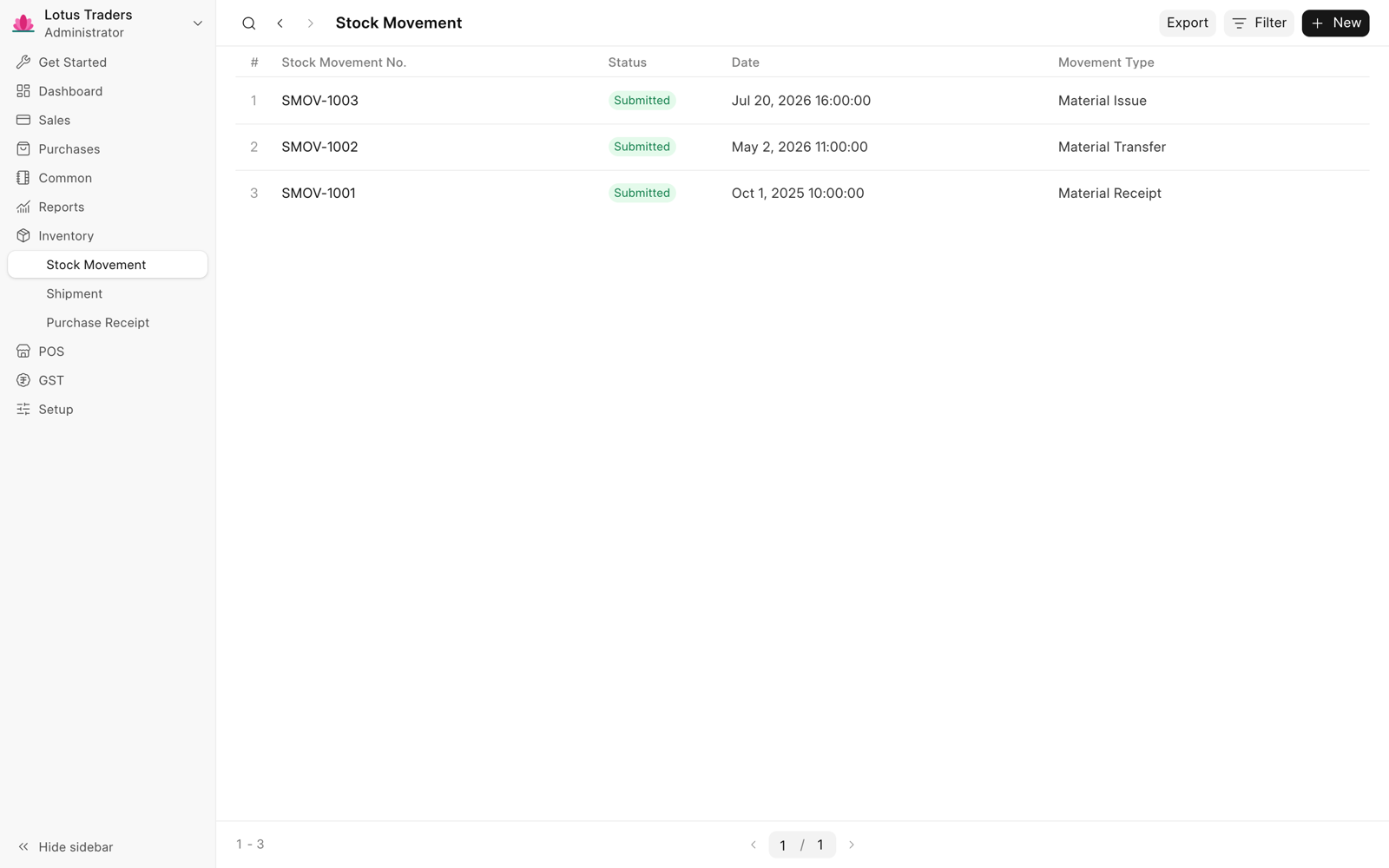
| Stock Movement | Moves stock into, out of, or between locations. |
| Shipment | Records stock that goes to a customer. |
| Purchase Receipt | Records stock that comes from a supplier. |
| Stock Ledger | Shows each stock entry. |
| Stock Balance | Shows the stock of each item at each location. |
A sales invoice or a purchase invoice can make its shipment or purchase receipt when you submit it. A Books User can make, submit, and cancel stock movements, shipments, and purchase receipts. Only a Books Manager or a System Manager can delete them.
Track an Item
- Make a new item. For the steps, see Items.
- Set Type to Product.
- In the Inventory section, select Track Inventory.
- Click Save.
You can select Track Inventory only on a new product, and you cannot change it after you save. Stock movements, shipments, and purchase receipts accept only these items. Their Purchase Acc. must be a liability account, and Frappe Books fills it with the Stock Received But Not Billed Acc.
Locations
Stock is always at a location. Frappe Books has a location called Stores, which is the Default Location. To add a location, type its name in a location field and click Create. Only a Books Manager or a System Manager can make locations. To see all your locations, search for Location in Quick Search.
Stock Quantity
An entry that takes stock out of a location needs enough stock there, on its date and on all later dates. The same check applies when you cancel an entry that brought stock in. If the stock is not enough, Frappe Books shows the available and the required quantity. Select a location that has enough stock, or bring the stock in first with an earlier date. To find a location, see Stock Balance.
Stock Valuation
Frappe Books values stock with the FIFO (first in, first out) method. Stock that comes in adds a layer at its rate. Stock that goes out takes the value of the oldest layers first, not the rate of its row. Each item, location, and batch has its own layers.
For example, you receive an item two times and then ship 15 units:
| Entry | Quantity | Rate | Value of the Entry | Stock Value After the Entry |
|---|---|---|---|---|
| Purchase receipt | 10 | 100 | 1,000 | 1,000 |
| Purchase receipt | 10 | 120 | 1,200 | 2,200 |
| Shipment | -15 | -1,600 | 600 |
The shipment takes 10 units at 100 and 5 units at 120. The 5 units that stay have a value of 600.
A Material Transfer and a shipment return bring the stock in at the value that went out.
When you submit or cancel an entry with an earlier date, Frappe Books calculates the later entries again and updates their accounting entries.
Stock Accounts
Frappe Books posts the change in the stock value to the accounts of the inventory settings. If one of the accounts that a document needs is empty, you cannot submit the document.
| Document | Debit | Credit |
|---|---|---|
| Purchase receipt | Stock In Hand | Stock Received But Not Billed |
| Purchase invoice for a tracked item | Stock Received But Not Billed | The payable account, such as Creditors |
| Shipment | Cost of Goods Sold | Stock In Hand |
| Stock movement that adds stock value, such as a Material Receipt | Stock In Hand | Stock Adjustment |
| Stock movement that removes stock value, such as a Material Issue | Stock Adjustment | Stock In Hand |
The purchase invoice and the purchase receipt cancel each other in Stock Received But Not Billed, so the stock value stays in Stock In Hand. A shipment then moves the value to Cost of Goods Sold. A Material Transfer makes no accounting entries.
Next Steps
- Check the accounts and the default location in Inventory Settings.
- Make your products with Track Inventory selected.
- Record the stock that you have now with a stock movement of the type Material Receipt.