

















A tax template has one or more tax rates and the accounts that get the tax. You set a tax template on each item. Frappe Books then calculates the tax of each invoice row from the template of the row.
Only a Books Manager or a System Manager can change tax templates.
Create a Tax Template
Before you start, make sure that your chart of accounts has a ledger account for each tax, such as below Duties and Taxes. See Create a New Account.
- Click Setup > Tax Templates in the sidebar.
- Click New.
- Enter a Name that shows the tax and its rate, such as
VAT 20%. You cannot change it after you save. - In Details, click Add row for each tax account. On a phone, fill in the row in the sheet that opens, and tap Done.
- In each row, select the Tax Invoice Account and enter the Rate in percent. The Tax Invoice Account gets the tax when you submit an invoice.
- Optional: Select a Tax Payment Account.
- Click Save.
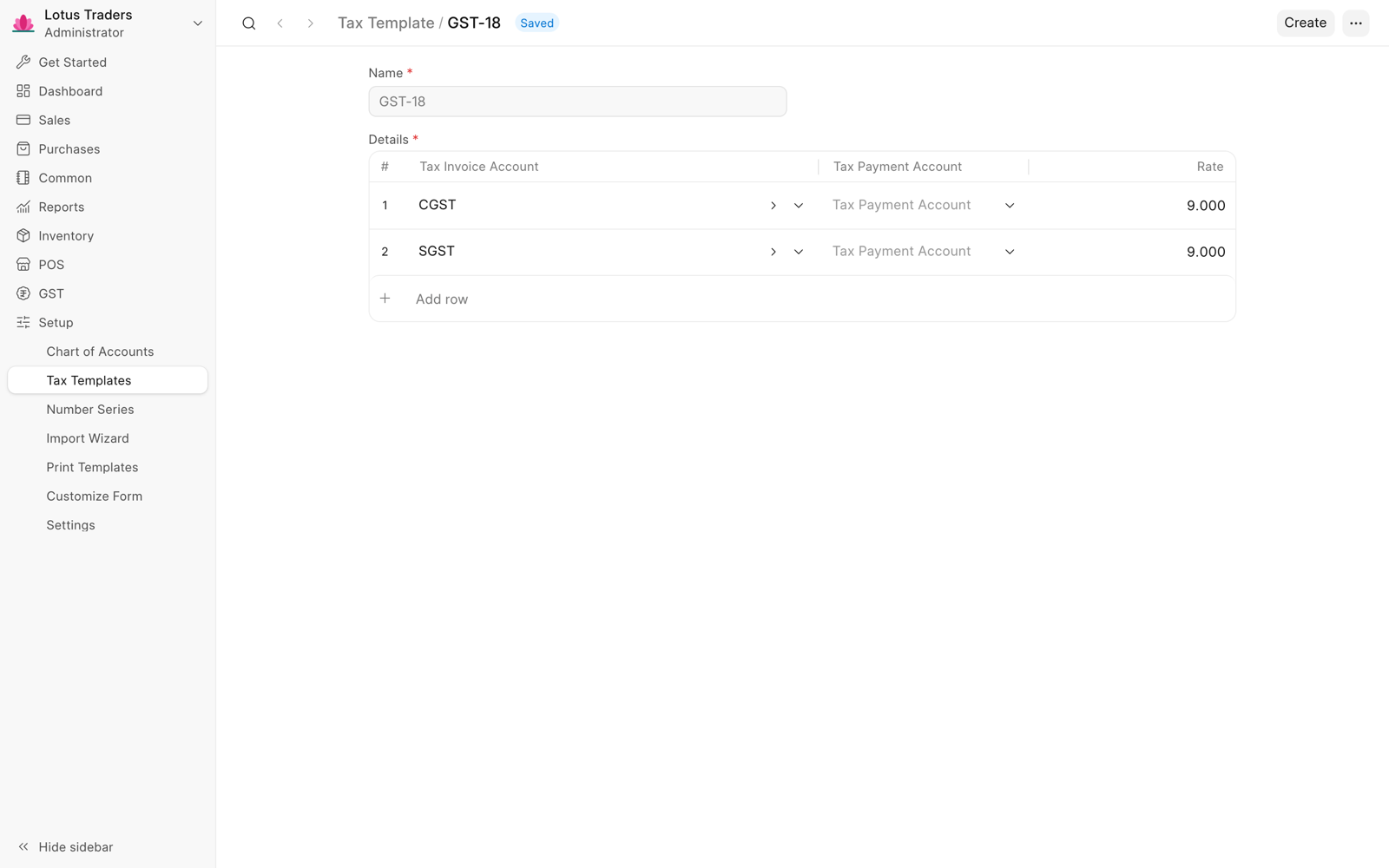
Use more than one row for taxes that you always charge together, such as CGST at 9 and SGST at 9. Each rate applies to the same amount, not to a different tax.
Taxes on Invoices
Select a template in the Tax field of each item. When you add the item to an invoice, the row gets this tax. If the item has no tax, the row gets the tax of the item group. To change the tax of one invoice row, select a different template in Tax, or clear it.
If the row has a discount, the tax is on the amount after the discount, unless you select Apply Discount After Tax. See Discount Accounting.
The Taxes table in the Tax and Totals section shows the total tax for each tax account. Sales quotes calculate the taxes in the same way.
When you submit a sales invoice, Frappe Books credits each Tax Invoice Account with the tax. A purchase invoice debits it. A return reverses these entries.
Tax Payment Account
Use the Tax Payment Account when you owe a tax only after the customer pays. The Tax Invoice Account keeps the unpaid tax. Each payment moves the paid part of the tax to the Tax Payment Account.
For example, a template has the Tax Invoice Account VAT Pending, the Tax Payment Account VAT Payable, and the Rate 10. A sales invoice of 1,000 has a tax of 100.
- When you submit the invoice, Frappe Books credits
VAT Pendingwith 100. - The customer pays 550, half the grand total. The payment moves 50 from
VAT PendingtoVAT Payable. - The customer pays the other 550. The payment moves the other 50.
For a purchase invoice, the entries go in the other direction. The Taxes table of the payment shows the moved amounts.
If two templates on one invoice have the same Tax Invoice Account, they must have the same Tax Payment Account. If not, Frappe Books does not save the payment.
Change or Delete a Template
A changed template applies to draft invoices when you save them again. Submitted invoices keep their taxes. To delete a template, click … > Delete in the page header. You cannot delete a template that an item or an invoice uses.
GST Tax Templates in India
When you set up a company in India, Frappe Books adds the accounts CGST, SGST, IGST, and Exempt below Duties and Taxes, and these templates:
| Tax Templates | Rows | Use |
|---|---|---|
| GST-28 to GST-0 | CGST and SGST, each at half the rate | A supply in your own state |
| IGST-28 to IGST-0 | IGST at the full rate | A supply to a different state |
| Exempt-GST-0, Exempt-IGST-0 | Exempt at 0% | An exempted supply |
The rates are 28, 18, 12, 6, 5, 3, 0.25, and 0. The GST reports get the tax amounts from the GST Head of each tax account. If you make your own GST accounts, set their GST Head in the chart of accounts. See GST Reports.